~/offensive security

Ethical Hacking

Ethical hacking is authorized security testing. The point is to find weaknesses before someone else does, then explain the risk clearly enough that it can be fixed. At CyberA4U this is taught as a professional skill, not as a shortcut around the law, consent, or operational safety.

What you actually practice

A useful ethical hacking path starts with how networks, operating systems, and applications behave. From there you learn reconnaissance, attack surface mapping, common web flaws, and how privilege, identity, and misconfiguration create real exposure. Labs exist to make those ideas concrete. Flags are a scoring mechanism, not the whole skill.

Ethics and scope come first

Permission, written scope, and careful handling of findings are part of the job. The platform does not treat unauthorized access as a learning method. If you want a career in offensive security, the habit of staying inside scope is as important as any technique.

How this connects to defense

Every useful offensive finding has a defensive counterpart: a detection, a control, a log source, or an incident-response play. Studying ethical hacking at CyberA4U is also a way to become a stronger blue-team analyst, because you learn what the attacker’s work looks like from the inside.

What you will learn

  • Authorized testing mindset, scope, and reporting habits
  • Reconnaissance and attack-surface thinking
  • Common web and network weakness classes
  • How offensive findings translate into defensive work

Related roadmaps

Related CyberA4U courses

In production

Red Team

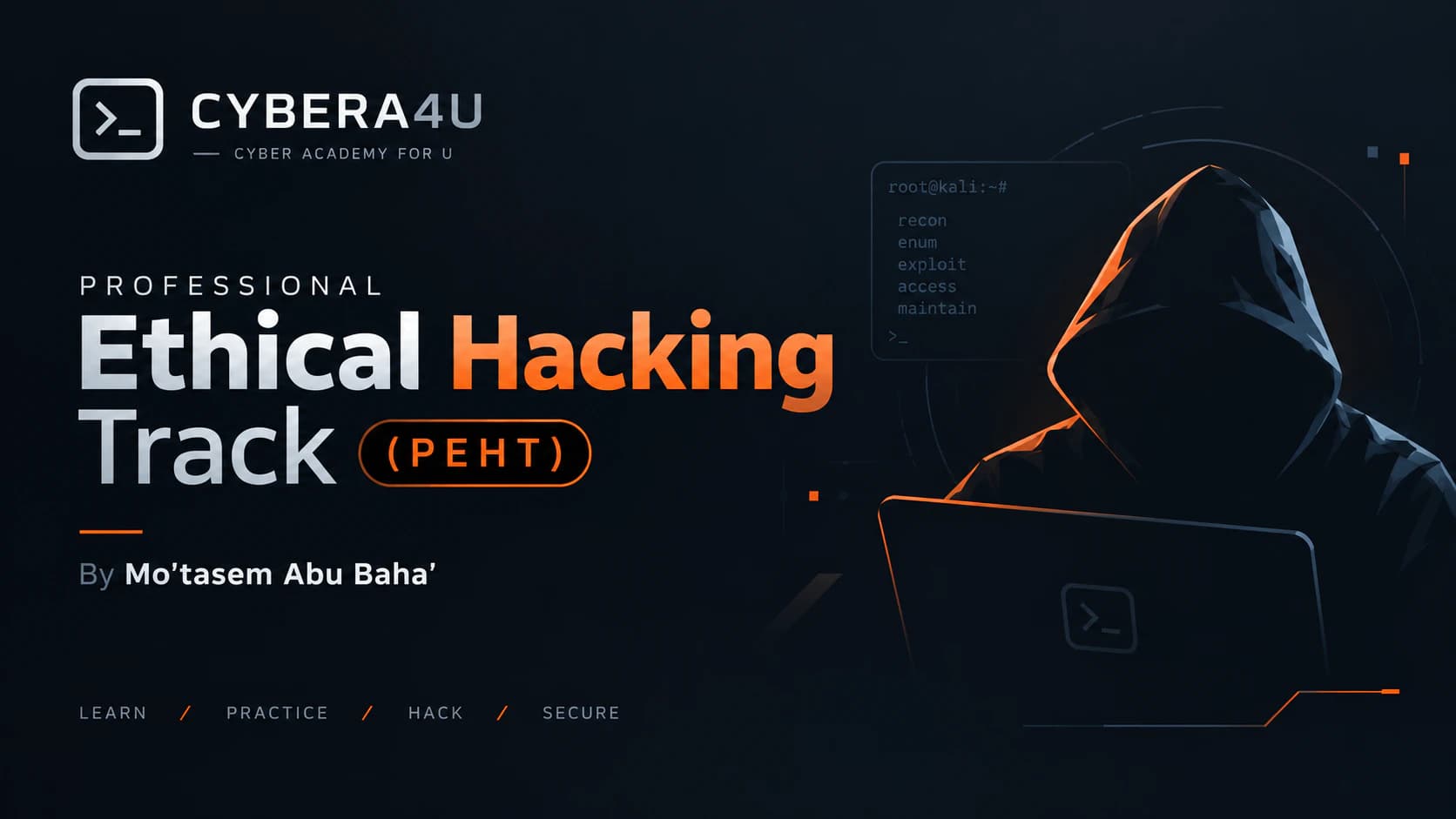
Professional Ethical Hacking Track (PEHT)

Professional Ethical Hacking Track (PEHT) — a hands-on offensive security program covering reconnaissance, scanning, exploitation, and post-exploitation techniques used by real-world attackers.

  • Beginner
  • 130 lessons
  • 50h

120 JOD

Mo'tasem Abu Baha'

Frequently asked questions

Is ethical hacking legal?

Yes, when you have explicit written permission for the systems you test and you stay within the agreed scope. Practising on your own lab or on platforms built for training, such as CTF challenges, is the safe way to learn.

What should I learn before ethical hacking?

Networking (TCP/IP, DNS, HTTP), Linux and Windows basics, and some scripting. Without these fundamentals, tools produce output you cannot interpret.

How is ethical hacking different from penetration testing?

Ethical hacking is the broad skill set; penetration testing is a structured, scoped engagement that uses those skills and ends with a written report for the client.

Related topics

Continue on CyberA4U